
Saginaw Township Previous Residents Sources
A backward address search needs records that answer separate questions. The assessor route supplies the current parcel and legal description. The Register of Deeds connects parties to recorded instruments. Hoyt Library adds dated household clues, while the census, newspapers, obituaries, probate records, and archival holdings help test the timeline. None makes a complete household list. Taken together, they can show a carefully dated sequence for a particular property and explain where the trail becomes uncertain.
| Record source | Time span stated | Where to use it | Address evidence |
|---|---|---|---|
| Assessment and parcel record | Current records; historical cutoff not located | Saginaw Township assessing, SAGA, or BS&A | Parcel, situs and mailing fields, classification, sale clues |
| Recorded deed index | Online cutoff not located | Register of Deeds, Tapestry, counter, or request | Grantor, grantee, legal description, and instrument trail |
| City directory collection | Hoyt says 1866-present; finding aid metadata says 1886-2024 | Hoyt Local History and archive finding aid | Heads of household, street address, occupation, and spouse clues |
| Federal census and local microform | Released census years only | Hoyt and historical research collections | Dated household snapshot, not current residence proof |
| Obituary and probate records | Coverage varies by series | Hoyt, Probate Court, and Archives of Michigan | Family, date, estate, and later record leads |
Start with the most recent reliable record. Move backward one event at a time. A deed can name parties without showing who occupied a house, and an old directory can name a head of household without proving ownership. That distinction makes the Saginaw Township previous residents trail useful for family history and house history without making claims the records do not support.
Saginaw Township Parcel First
Record the parcel number, current situs address, owner field, mailing field, subdivision lot and block, or metes-and-bounds description before opening a deed index. A situs address identifies the physical parcel. A mailing address is where tax or owner correspondence goes. They may match, but the second field is not evidence that the addressee lived there. The legal description is especially valuable when an old street label, replat, or parcel split makes a modern address search fail.
SAGA Fetch and BS&A advertise address, owner-name, and parcel searches. The current local field layout and historical coverage were not fully captured, so use the live tool rather than assuming a particular filter exists. SAGA also cautions that parcel lines are not survey-accurate. For a boundary question, rely on the deed, plat, survey, or legal description, not a map line alone.
- Parcel
- A tax and mapping unit that connects an address to land records.
- Situs address
- The physical street location assigned to the parcel.
- Legal description
- The land description used in recorded instruments; it often survives changes to a street label.
- Chain of title
- A sequence of recorded transfers that connects owners through time.
Saginaw Township Deed Chain
The Saginaw County Register of Deeds maintains recorded real-property instruments, original subdivision plats, and legal descriptions. Its online route is Tapestry, but the inspected page did not reveal its search fields, image rules, or oldest online date. The county gives a sound fallback: provide the property owner name, property address, and approximate purchase date by email, phone, fax, or in person. The public workstation at the office is free. A counter search costs $5, copies cost $1 per page, and certification costs $5 per document.
- Find the parcel and legal description in the current assessing or mapping record.
- Use the current owner, address, and approximate purchase date to search Tapestry or request help from the Register of Deeds.
- Record the newest instrument's grantor, grantee, recording date, document type, and legal description.
- Search the seller as a prior grantee, then repeat the process one transfer at a time.
- When an estate, trust, or entity appears, preserve the exact indexed name and use probate or business filings only as a bridge to the next recorded document.
Grantor means the party transferring an interest. Grantee means the party receiving it. A quitclaim instrument may settle title or confirm a relationship rather than document a conventional sale, so do not read every transfer as a market purchase. The county's Tapestry cutoff is not stated in the research. For earlier or unclear material, ask the office about the counter, a copy request, or the appropriate older-record route.
County Desk Fills Index Gaps
The county offers more than one channel when an online record is incomplete. The Register of Deeds accepts owner, address, and approximate-date search requests by email, phone, fax, or in person. Contact-free copy instructions also describe mail, cash or check, a courthouse drop box, and a courtesy check by email. Those options matter when a name is spelled differently, the property has been replatted, or the internet index does not expose an older instrument.
Saginaw County's Register of Deeds fee page separates copy, certification, search, and recording charges, which helps distinguish research from a request for an official copy.
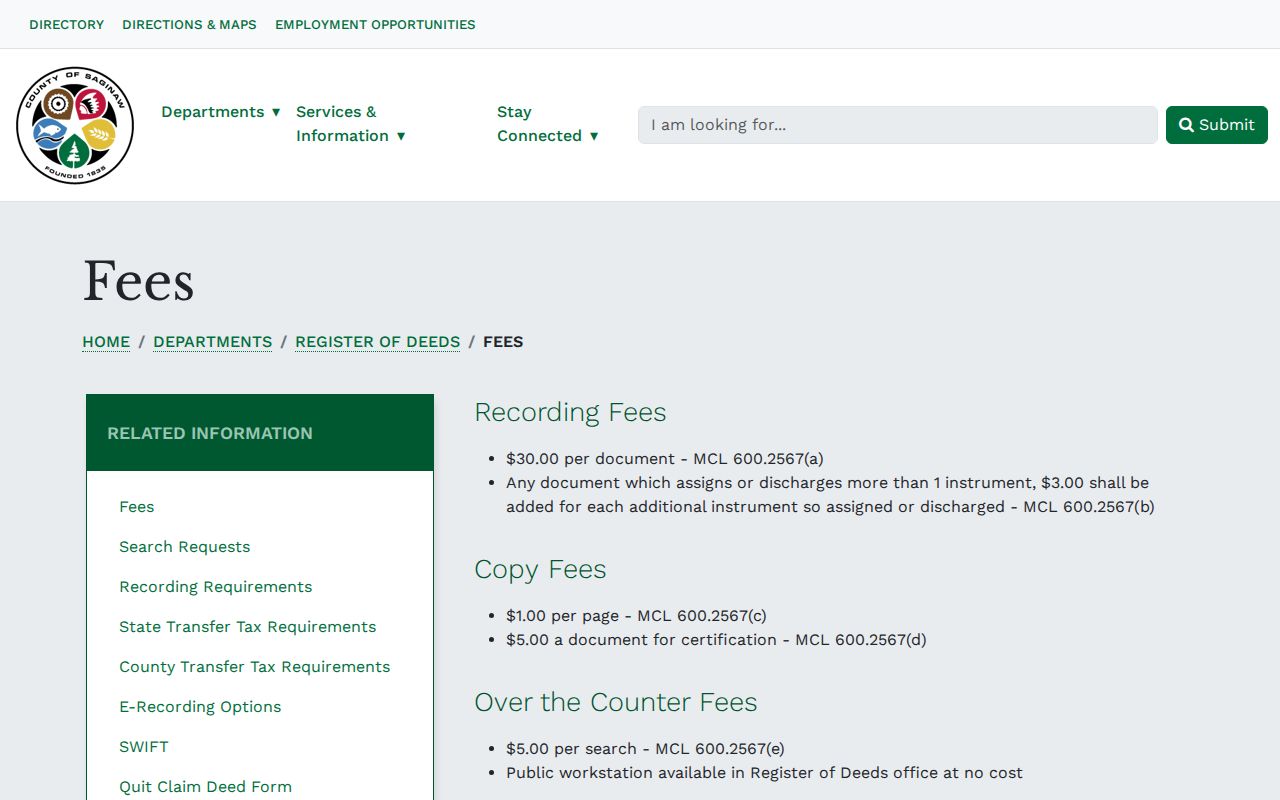
Use the fee schedule to plan a targeted request after identifying the document, not to assume an online image or a historic index range is available.
Saginaw Township Household Snapshots
For past residents, a deed chain gives ownership while directories and census material supply household clues. Hoyt's Local History and Genealogy department holds city directories, newspapers on microfilm, cemetery and biography resources, oral histories, atlases, plat books, and census materials. The directories can include a head of household, spouse in parentheses, address, occupation, and sometimes an owner or occupant mark. They are library-use-only, and copying depends on condition and rights.
- Choose a directory volume close to the transfer date from the deed chain.
- Check the surname entry, then use Polk street order or a Bresser criss-cross volume where available to test the house number.
- Pair that year with the relevant released census or local microform material as a separate household snapshot.
- Search adjacent years when a family vanishes, because a move, a renumbering, or a publication gap can mimic a missing person.
- Keep the volume, page, city label, and date with each finding.
The 1890 consolidation creates a local naming trap. The finding aid groups East Saginaw and Saginaw City volumes before consolidation and Saginaw material afterward. Try the old city label with the street and house number before deciding that a record is absent. The full collection details belong on the Saginaw Township directory book page.
Saginaw Township Map Clues
Maps can support a house history without naming occupants. The Library of Congress holds a 1950 Saginaw map set with 87 sheets from a volume dated 1935 through March 1950. It can help with street context and structure history, but the identified set covers Saginaw city and does not establish township-wide Sanborn coverage. A plat, parcel description, or deed remains the safer bridge for a Saginaw Township property.
Open the Saginaw County genealogy page for the county's historical-record request route.
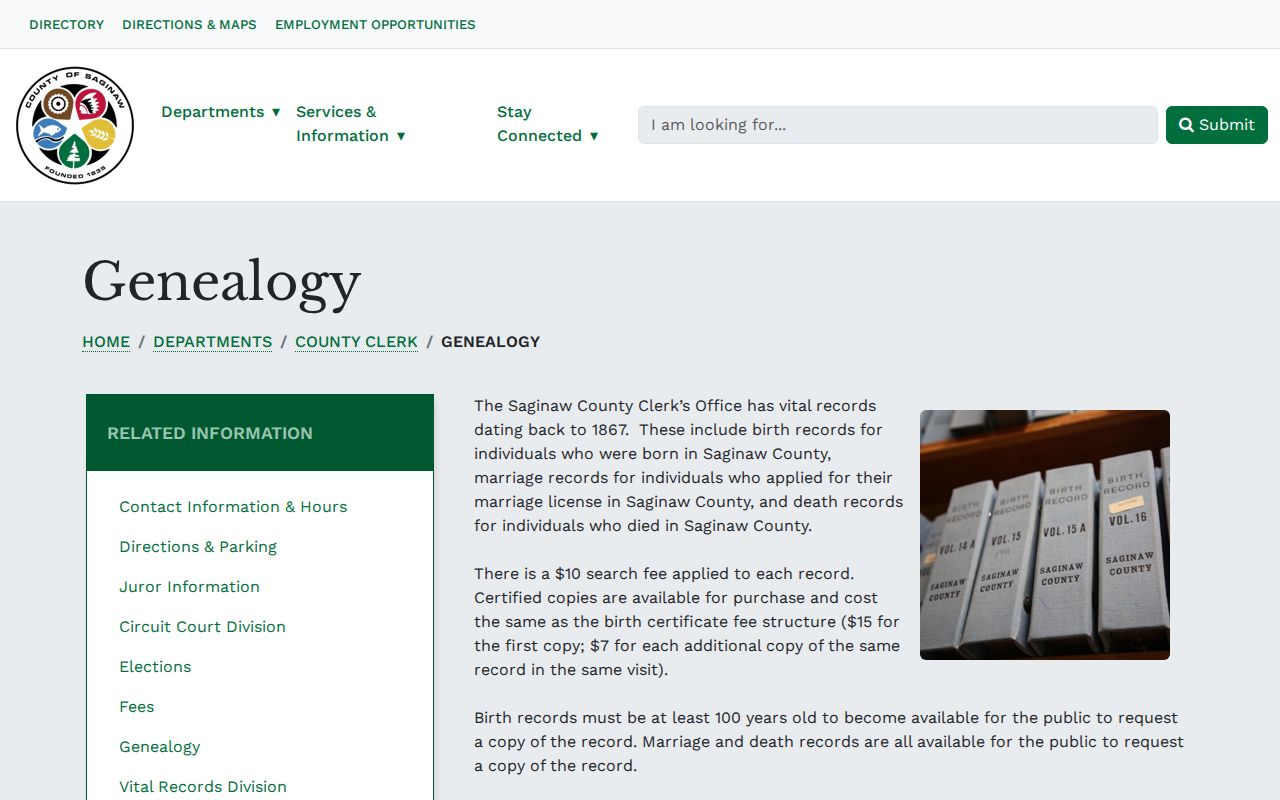
The county genealogy route begins with events from 1867 and requires an in-person request with a $10 search fee per record, so it is a dated clue source rather than a substitute for an online household list.
Saginaw Township Estate Endpoints
An obituary or probate file can explain the final appearance of a former household in a directory. Hoyt's obituary index covers more than 250,000 Saginaw News entries and exposes fields such as newspaper, date, page, spouse, cemetery, and funeral home. It can point to a family relationship or date, but it does not by itself prove that a person held title or remained at the address.
For probate, identify a party name or case number. The local probate administrative order says a general request to find everything is not enough. Archives of Michigan lists Saginaw County probate files from 1837-1968, index cards from 1837-1991, and miscellaneous estate files from 1915-2015. Vital records can add event evidence through the County Clerk or MDHHS, subject to the applicable eligibility and certification rules.
The County Clerk's Vital Records Division shows the local route for certified copies and related requests.
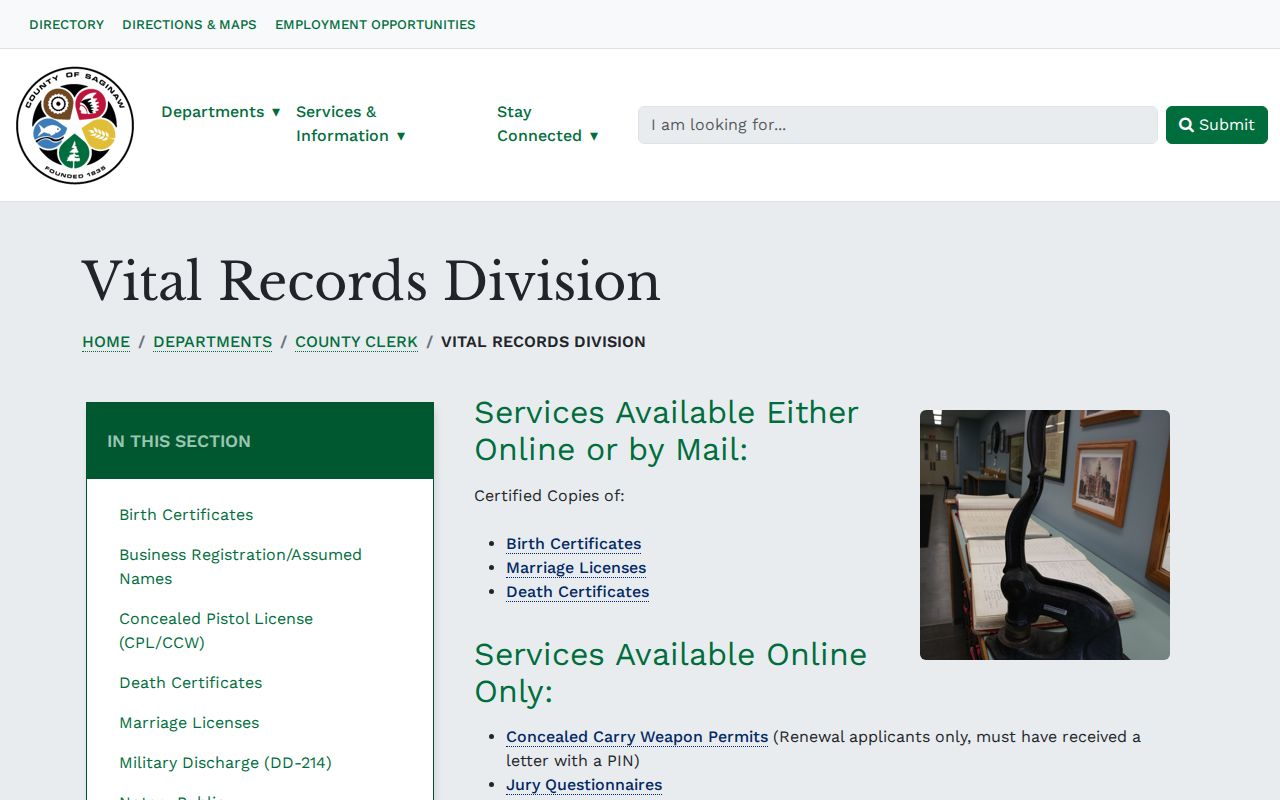
A certificate and a genealogy clue serve different purposes, so ask the custodian which record type and access channel fits the question.
Saginaw Township Previous Residents Limits
Previous residents research does not identify every person who slept at an address. Renters, unlisted household members, delivery recipients, utility customers, protected voters, and people covered by an address-confidentiality program may never appear in the public trail. A current owner may have acquired land long after an earlier household moved. Treat each result as a dated record of the custodian's purpose, not a live roster.
Lawful use. Use past-resident research for family history, house history, estate questions, or personal curiosity. Do not use names, addresses, or record clues to stalk, harass, or harm another person.